Why an economist and an engineer bet everything on AI
For generations, scale was the decisive advantage in business. Artificial intelligence is quietly dissolving that certainty, and we have staked our careers on what comes next.
In 30 seconds
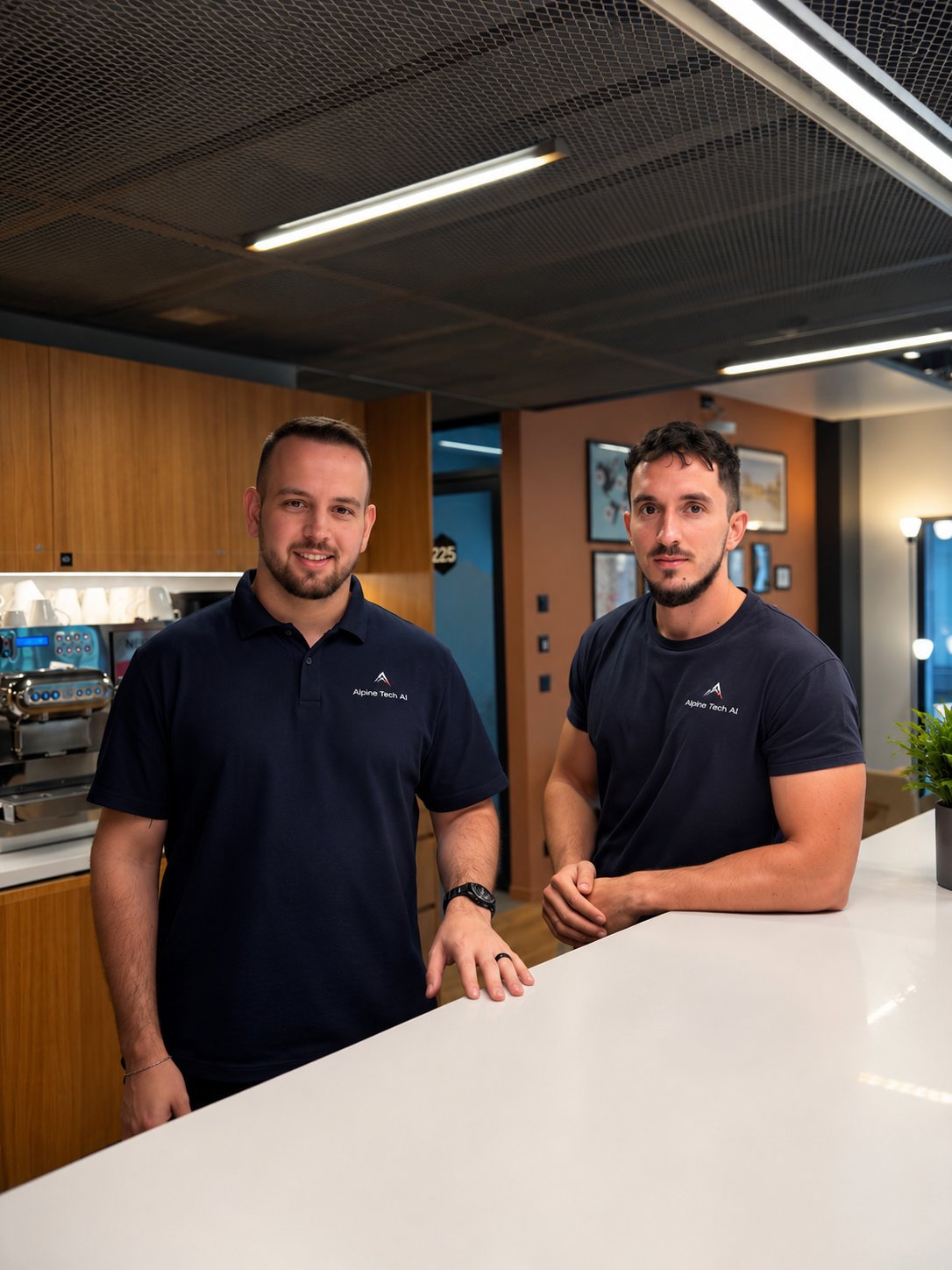
For generations, size decided who prevailed. With AI, it no longer has to. An AI-native company can hold its own against competitors of any size, and SMEs stand to gain the most. Nordin taught himself Python during the COVID lockdown and never looked back. Dmytro has spent years building software across Europe and the United States. Together we build Alpine Tech AI GmbH, an AI-first agency that helps companies become AI-native.
For generations, size was the quiet arbiter of competition. The larger enterprise commanded deeper reservoirs of knowledge, a broader pool of talent, denser networks of relationships, and the resources to bind them all together. More often than not, it prevailed.
It still leads today. Yet artificial intelligence is redrawing the boundaries of who may compete. A small team that builds its work around AI can now accomplish what once required an entire department. Not in some distant decade. Within the next few years.
None of this is an argument for leaner headcounts. The real promise lies in what your existing people become once AI carries the repetitive weight of their days. Released from routine, they take on work of greater consequence, cultivate skills they never had room to develop, and step confidently into disciplines they once observed only from the sidelines. AI should never be the reason people leave. It should be the reason they grow.
That is the wager we have made. This is why.
Curiosity came first
It began during the COVID lockdown. With the world suspended in an unfamiliar stillness, Nordin opened a Python tutorial and taught himself to code. It was meant to be a modest side skill for someone heading into a career in finance. Instead, it kindled a fascination that has never faded.
He pursued it with intent: a master's degree in finance and data science, with programming at its core, and, more recently, a master's degree in artificial intelligence.
If his studies gave him the method, travel gave him perspective. He has journeyed to the Middle East, throughout Europe and, time and again, to the United States, frequently on his own. Each journey is an exercise in curiosity: new cultures, new places and, above all, new people, each with their own way of thinking and working. Recently, those journeys have woven a network of people building with AI across several continents. What captivates him most is how AI keeps opening possibilities that seemed out of reach only recently, and how those possibilities multiply when people pursue them together.
Dmytro arrived from the opposite direction. Engineering has fascinated him for as long as he can remember. He has lived in several European countries and built software for companies in Europe and the United States, absorbing how teams in very different cultures design, build and endure, and what a system demands to keep running long after launch day. Today he builds scalable AI systems for tangible business problems. To him, AI is the most compelling engineering challenge of his career, for the sheer breadth of what it allows one to build.
Two years ago, our paths crossed in Switzerland. We are both part of the AAA Accelerator, the largest international community of AI enthusiasts and founders. We have been building side by side ever since, from the first prototypes to Alpine Tech AI.
Both of us are convinced AI can do genuine good. Rarely has a technology this powerful been this within reach. Much of today's most capable AI is freely available, or costs little more than a monthly subscription. A founder in Europe, a student in the Middle East and a craftsman in a small village in Africa can all build with intelligence that, only a few years ago, no money could buy. Money still buys more. But it no longer decides who gets to begin. For us, that is the most remarkable promise of AI.
An economist who asks why. An engineer who asks how. Two paths, one curiosity.
It could be so much simpler
In our years as employees, wherever we worked, we encountered the same quiet paradox: gifted people devoting their days to work that could be far simpler. Not through any failing of their own, but because no one ever had the time to step back and ask what the work might look like instead.
That question is the part of our craft we cherish most. Before we speak about AI, we listen. We sit with people to understand their needs, their frustrations and the true rhythm of their day, until we see their business through their eyes. Only then do we think about what AI could change. And we never leave empty-handed. We arrive to understand. We depart having been taught.
Why we built an AI-first agency
We truly believe AI can unsettle the status quo of the corporate world. Companies that become AI-native will compete on terms once reserved for the largest players.
Large corporations possess the budgets. What they frequently lack is agility. Every step with AI demands careful scrutiny, because costs can escalate with startling speed. And reshaping how hundreds of people work takes years, for it alters the culture, not merely the software.
SMEs play by different rules. Fewer layers. Swifter decisions. Nothing to unlearn. A young company, or any organisation with agile processes, can become AI-native far sooner.
That conviction is why we founded Alpine Tech AI, an AI-first agency in Zurich that helps companies become AI-native. We believe AI should be accessible, practical and create genuine value, for everyone.
We equip your teams to work confidently with AI. We chart a course grounded in your business goals. We build systems that hold up in daily use. And when AI is not the right answer, we are the first to say so.
What awaits you here: two notes a week. Real problems, real numbers, what we would do and where we went wrong.
"The goal isn't fewer people. It's people doing meaningful work that moves them and the company forward." — Nordin
Becoming AI-native is not about replacing your team. It is about people in your company using AI, testing it, questioning its results and growing more confident with it every week. That is what frees them for more demanding work, and demanding work, done well, is one of the strongest motivators there is.
If you rebuilt your company from scratch tomorrow, which tasks would you leave behind?
Your next step
Subscribe to Insight Notes. Two notes a week, drawn straight from our work. No hype, no sales pitch.
Sources & further reading
Last substantive update: